
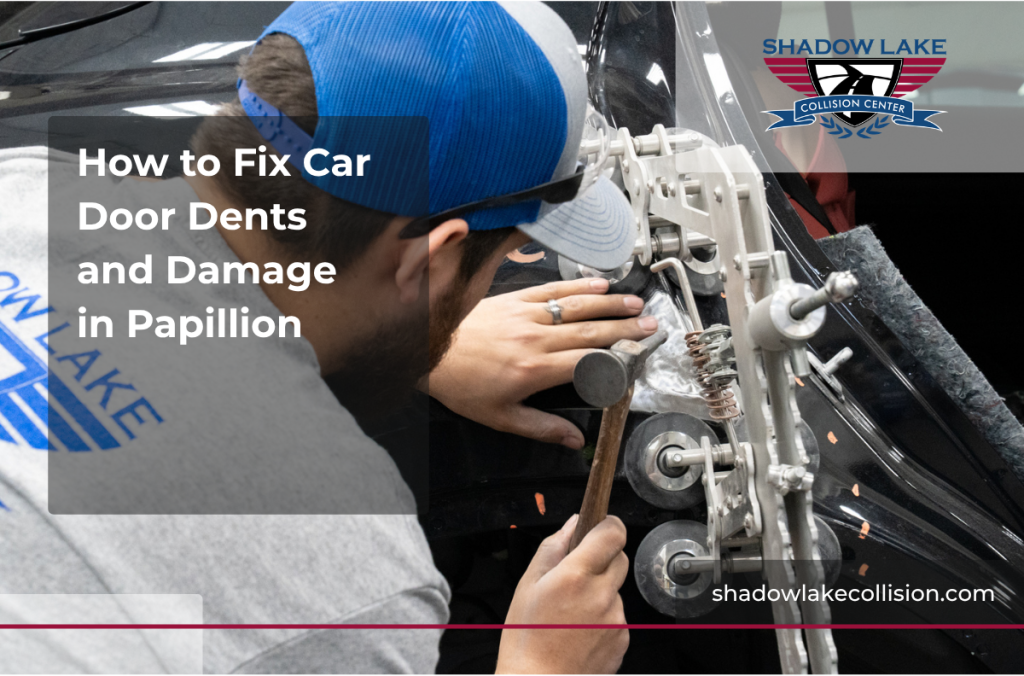
SUMMARY
- Car door damage can range from small parking-lot dents to severe collision damage involving the door shell, intrusion beam, hinges, latches, wiring, glass, or surrounding body structure.
- Small dents with intact paint may sometimes qualify for Paintless Dent Repair (PDR), which reshapes the panel without conventional refinishing.
- Deeper dents, sharp creases, stretched metal, or damaged paint may require conventional auto body repair and refinishing.
- Severe damage can require replacement of the door skin or complete door assembly, depending on the construction, damage, and manufacturer repair procedures.
- Door damage should not be judged by appearance alone. I-CAR explains that the door intrusion beam is an occupant-protection component located behind the outer door skin. If that beam is damaged, it should not simply be straightened.
- NHTSA’s side-impact standards recognize the importance of door and side-body structures in limiting intrusion into the passenger compartment during a collision.
- Modern doors can also contain side-impact sensors, wiring, window regulators, cameras, mirrors, locks, and other electronics that may require inspection after a collision.
- If a door no longer opens, closes, latches, seals, or aligns correctly after an accident, professional inspection is recommended.
- Shadow Lake Collision at 1215 Applewood Dr, Papillion, NE 68046, United States provides professional auto body, collision, and paintless dent repair for damaged vehicle doors.
A dented car door might seem like one of the simplest types of auto body damage.
Sometimes it is, but not always.
A shallow parking-lot ding with intact paint may be an excellent candidate for Paintless Dent Repair. But damage caused by a harder impact can involve much more than the visible outer panel.
Inside a modern vehicle door, you may find:
- Intrusion reinforcement
- Window regulator
- Wiring
- Speakers
- Locks
- Latches
- Side-impact-related components
- Mirror electronics
The door also needs to fit correctly against the surrounding:
- Roof
- Pillars
- Rocker
- Adjacent panels
That means the right way to fix a damaged car door depends on how the damage happened, where it is located, how severely the panel was deformed, whether the paint was damaged, and whether internal or structural components were affected.
For drivers in Papillion, NE, understanding these differences can help determine whether a door needs PDR, conventional body repair, a replacement panel, or a more extensive collision repair.
Shadow Lake Collision, located at 1215 Applewood Dr, Papillion, NE 68046, United States, provides professional auto body repair, collision repair, and Paintless Dent Repair for damaged vehicles.
What Types of Car Door Damage Can Be Repaired?
Many types of door damage can potentially be repaired.
Common examples include:
- Door dings
- Shallow dents
- Hail dents
- Creases
- Scratches
- Chipped paint
- Larger collision dents
The appropriate method depends on more than the size of the damaged area.
Technicians also evaluate:
- Dent depth
- Location
- Metal stretching
- Paint condition
- Door material
- Access behind the damage
- Condition of internal components
- OEM repair procedures
A large shallow dent can sometimes be more repairable than a smaller but extremely sharp crease.
What Causes Car Door Dents in Papillion?
Door damage can happen almost anywhere.
Common causes include:
- Another vehicle door opening into yours
- Shopping carts
- Parking-lot impacts
- Hail
- Road debris
- Sideswipe collisions
- Backing accidents
- Objects falling against the vehicle
The type of impact often gives technicians clues about what they need to inspect.
A small door ding is very different from a side collision where another vehicle pushed the entire door inward.
Can a Small Car Door Dent Be Repaired?
Often, yes.
Small dents may be repairable if:
- Metal has not been severely stretched
- Paint remains in suitable condition
- Damage is accessible
- No reinforcement or internal component was affected
The technician determines whether the dent is suitable for:
- Paintless Dent Repair
- Conventional body repair
Simply knowing the diameter of the dent is not enough to determine the best method.
Their depth, shape, and location matter just as much.
What Is Paintless Dent Repair for a Car Door?
Paintless Dent Repair, commonly called PDR, is a technique used to reshape certain dents while preserving the existing paint finish.
Depending on the location, technicians may gain access behind the panel and carefully manipulate the damaged area back toward its original contour.
PDR can potentially avoid:
- Body filler
- Primer
- Basecoat
- Clearcoat
when the damage qualifies.
Shadow Lake Collision provides Paintless Dent Repair for suitable dents in Papillion.
What Door Dents Are Good Candidates for PDR?
PDR may be appropriate for:
- Door dings
- Shallow dents
- Certain minor creases
- Hail dents
Important considerations include:
- Paint condition
- Dent depth
- Dent location
- Panel material
- Accessibility
PDR is not automatically appropriate simply because the dent appears small.
A tiny but extremely sharp dent can sometimes be more difficult than a broad, shallow depression.
Can Hail Dents on Car Doors Be Repaired With PDR?
Frequently, yes, when the dents and paint condition are suitable.
Hail can affect multiple parts of a vehicle, including:
- Roof
- Hood
- Trunk
- Fenders
- Doors
PDR is commonly considered for hail damage because many hail impacts deform the panel without necessarily breaking the paint.
However, conventional repair may be necessary when:
- Paint is cracked
- Damage is unusually deep
- Panel is significantly stretched
- Access is restricted
Shadow Lake Collision offers both hail damage repair and PDR, allowing the repair approach to be based on the actual condition of the vehicle.
When Does a Door Dent Need Conventional Auto Body Repair?
Conventional repair may be more appropriate when the damage involves:
- Cracked paint
- Deep crease
- Stretched metal
- More extensive deformation
- Surface damage requiring refinishing
The process can include:
- Accessing the damaged area.
- Reshaping the panel.
- Refining the surface.
- Preparing it for refinishing.
- Applying primer where required.
- Applying basecoat.
- Applying clearcoat.
- Reassembling removed components.
The specific process depends on the vehicle and extent of damage.
Can a Creased Car Door Be Repaired?
Sometimes.
Creases can be more challenging than broad dents because the collision force is concentrated along a narrow area.
Technicians evaluate:
- Sharpness
- Depth
- Length
- Metal stretching
- Location
A crease through a relatively open section of the door skin may present a different repair situation from one running through:
- Body line
- Door edge
- Reinforcement area
Some creases can be repaired while others make replacement more practical.
Can Scratches on a Car Door Be Repaired?
Yes, but the repair depends on how deeply the scratch penetrated the finish.
A light scratch may affect only the clearcoat.
A deeper scratch may reach:
- Basecoat
- Primer
- Bare metal
Damage extending through the protective finish requires more attention because exposed metal can become vulnerable to corrosion.
A professional evaluation can determine whether the area needs:
- Polishing
- Localized refinishing
- More extensive panel refinishing
What If the Door Dent Also Cracked the Paint?
Once the paint has cracked, traditional PDR alone generally cannot restore the complete finish.
The metal may still be repairable, but the damaged finish needs to be addressed.
Conventional auto body repair may include:
- Metal repair
- Surface preparation
- Primer
- Color application
- Clearcoat
Leaving damaged paint untreated can expose underlying materials to moisture and environmental conditions.
Can a Car Door Be Too Damaged to Repair?
Yes.
Replacement may become more appropriate when damage involves:
- Severe deformation
- Torn metal
- Extensively stretched material
- Destroyed mounting locations
- Damaged intrusion reinforcement
- Manufacturer repair restrictions
The decision should not be based solely on whether a technician could make the exterior look better.
The complete door assembly and its function need to be considered.
What Is a Door Skin?
The door skin is the exterior panel that creates much of the visible surface of the door.
Behind it is the door shell and internal construction.
Depending on the vehicle, repairing door damage could involve:
- Repairing the existing outer panel
- Replacing a serviceable outer door skin
- Replacing the complete door assembly
The correct approach depends on the damage and manufacturer repair information.
Can Just the Door Skin Be Replaced?
Sometimes.
Certain manufacturers provide replacement outer door skins or outer panels.
This can allow technicians to retain portions of the existing door while replacing the severely damaged exterior panel.
However, a door skin replacement is not appropriate when the underlying door structure has damage that requires a different repair.
Technicians should inspect:
- Door shell
- Reinforcement
- Hinge areas
- Latch areas
before deciding that replacing only the outer panel is sufficient.
When Does the Entire Car Door Need Replacement?
Complete door replacement may be necessary when significant damage affects areas that cannot or should not be repaired.
Examples can include:
- Severe door-shell deformation
- Damaged intrusion beam
- Significant hinge mounting damage
- Major latch-area deformation
- OEM repair restrictions
I-CAR explains that when a welded door intrusion beam is damaged, replacement of the door shell is required rather than straightening the beam.
That is an important distinction because damage behind the outer skin can change the entire repair strategy.
What Is the Door Intrusion Beam?
The intrusion beam is a reinforcement inside the door.
It is positioned behind the outer door skin and plays an important role in occupant protection during side impacts.
I-CAR explains that a door intrusion beam is an occupant-protection component and that a damaged beam should not be straightened.
Depending on how the beam is attached, damage can require:
- Beam replacement
- Complete door-shell replacement
This is one reason technicians need to look beyond the visible dent after a significant side impact.
Why Shouldn’t a Damaged Door Intrusion Beam Simply Be Straightened?
The intrusion beam is designed to help manage collision forces.
I-CAR states that straightening or repairing a damaged intrusion beam or its mounting locations could compromise occupant protection.
I-CAR’s broader repairability guidance also identifies the door intrusion beam as an area where straightening is not an appropriate repair approach.
The appropriate repair therefore needs to follow the construction and manufacturer requirements for that specific vehicle.
Do Vehicle Manufacturers Have Their Own Door Repair Rules?
Yes.
Repair requirements can vary by manufacturer and vehicle.
For example, I-CAR reports that Toyota prohibits repair of damaged intrusion beams and calls for complete door replacement when an intrusion beam is damaged.
Honda similarly states that high-strength-steel door reinforcements should not be repaired or straightened.
These examples demonstrate why collision technicians should research the specific OEM repair procedure rather than assuming the same method applies to every damaged door.
Why Is Door Structure Important in a Side Collision?
There is less space between an occupant and an impact occurring directly beside the passenger compartment than there is in many frontal collisions.
NHTSA‘s side-impact safety documentation explains that vehicle doors and side structures play an important role in managing intrusion during side collisions. Federal Motor Vehicle Safety Standard No. 214 establishes side-impact protection requirements for passenger vehicles.
This is why significant collision damage to a door deserves more attention than simply restoring its cosmetic appearance.
What Other Components Are Inside a Car Door?
Depending on the vehicle, a door can contain:
- Window regulator
- Window motor
- Glass
- Wiring harness
- Speakers
- Lock actuator
- Latch
- Handle mechanisms
- Side-impact reinforcement
- Electronic modules
Some doors may also interact with:
- Mirror cameras
- Blind-spot systems
- Keyless entry
- Seat-memory controls
A collision can damage these components even when the exterior panel receives most of the visible impact.
Can a Door Dent Damage the Window?
Potentially.
Significant door deformation can affect:
- Glass
- Window tracks
- Window regulator
- Internal mounting points
Warning signs include a window that:
- Moves slowly
- Makes unusual noises
- Tilts while moving
- Stops before fully closing
- No longer operates
If the symptoms appeared immediately after a side impact, the door should be inspected rather than assuming the window motor independently failed.
Why Won’t My Car Door Close Properly After an Accident?
Several collision-related problems can affect door operation.
Possible causes include:
- Bent door shell
- Damaged hinges
- Misaligned striker
- Deformed surrounding structure
- Damaged latch
- Panel interference
Do not repeatedly slam a damaged door to force it closed.
That can potentially damage:
- Latch
- Striker
- Trim
- Glass
Professional inspection can determine whether the problem is confined to the door or involves the surrounding vehicle structure.
What If the Door Opens but Doesn’t Line Up Correctly?
Look at the gaps around the door.
A properly positioned door should generally have reasonably consistent relationships with adjacent panels.
After a collision, you may notice:
- Gap wider at one end
- Door sitting inward
- Door sticking outward
- Edge contacting another panel
These conditions may indicate:
- Door deformation
- Hinge movement
- Surrounding body damage
Alignment problems should be diagnosed rather than simply adjusting the latch until the door closes.
Can Door Hinges Be Damaged in a Collision?
Yes.
An impact can potentially affect:
- Hinges
- Hinge mounting areas
- Door shell
- Adjacent pillar
Symptoms can include:
- Door sagging
- Difficulty closing
- Uneven panel gaps
- Door contacting another panel
Technicians need to determine exactly where the misalignment originates.
Simply adjusting the hinge may not address underlying structural damage if the surrounding attachment area moved during the collision.
Can the Door Latch Be Damaged?
Yes.
A latch needs to engage properly with the striker so the door remains secured.
Collision damage may affect:
- Latch
- Striker
- Door shell
- Mounting areas
If the door:
- Does not latch
- Pops open
- Requires excessive force to close
have it inspected promptly.
Door operation is not merely a cosmetic concern.
Can a Side Collision Damage the B-Pillar?
Yes.
The B-pillar is generally the vertical body structure between the front and rear door openings on many passenger vehicles.
A significant side impact can affect:
- Door
- B-pillar
- Rocker
- Roof-side structure
Damage extending beyond the bolt-on door becomes a more involved collision repair.
Technicians may need:
- Structural measurements
- OEM repair procedures
- Specialized repair equipment
This is substantially different from repairing a parking-lot door ding.
Can the Rocker Panel Be Damaged Along With the Door?
Yes.
The rocker runs along the lower portion of the vehicle body beneath the doors.
A side collision can push damage into both:
- Door
- Rocker area
If the rocker is damaged, technicians need to determine whether the problem involves:
- Outer cosmetic panel
- Underlying structure
- Both
Professional collision repair evaluates how far the collision forces traveled rather than limiting the repair plan to the most obvious dent.
How Can Technicians Tell Whether Damage Is Structural?
Technicians examine:
- Panel alignment
- Door openings
- Welded structures
- Pillars
- Rockers
- Mounting locations
Depending on the severity of the collision, they may also use:
- Vehicle measurements
- OEM repair information
A door that no longer fits correctly can sometimes be an early clue that the problem extends beyond the outer panel.
However, measurement and inspection are needed to determine the actual cause.
Can a Side-Impact Sensor Be Affected by Door Damage?
Potentially, depending on the vehicle and collision.
Modern vehicles can contain crash-sensing and restraint-system components in areas affected by side impacts.
If a significant collision has occurred, technicians may need to consider:
- Diagnostic trouble codes
- Manufacturer procedures
- Restraint-system inspections
The exact requirements vary by vehicle.
A professional collision repair plan should therefore consider electronic systems in addition to visible body damage.
Can ADAS Technology Be Involved in Door Repairs?
Yes, depending on the vehicle.
Modern side mirrors may incorporate:
- Cameras
- Blind-spot indicators
- Other electronics
Doors can also contain wiring that communicates with other vehicle systems.
If a collision damages or requires removal of certain technology, technicians should research manufacturer-specific procedures to determine whether additional:
- Diagnostics
- Aiming
- Calibration
are required.
The requirement depends on the specific system and repair.
Can a Damaged Side Mirror Affect the Door Repair?
Yes.
Side mirrors commonly attach directly to the door.
An impact to the mirror can potentially damage:
- Mirror housing
- Mounting area
- Wiring
- Door panel
Modern mirrors may also contain:
- Cameras
- Turn signals
- Heating elements
- Blind-spot indicators
If the mirror was struck hard enough to damage its mounting area, technicians should inspect the door itself rather than replacing only the mirror automatically.
Can a Car Door Leak After an Accident?
Yes.
Collision damage can affect how the door seals against the body.
Potential symptoms include:
- Water entering the cabin
- Wind noise
- Damp carpeting
- Excessive road noise
Possible causes include:
- Door misalignment
- Damaged weatherstripping
- Deformed opening
- Damaged door shell
A leak that begins immediately after a collision should be evaluated as part of the repair rather than treated as an unrelated maintenance problem.
Why Does Paint Matching Matter When Repairing a Door?
When conventional repair or replacement requires refinishing, the repaired door needs to visually integrate with the rest of the vehicle.
Automotive paint can vary because of:
- Factory color variants
- Vehicle age
- Previous repairs
- Metallic or pearl content
- Application differences
A refinisher may need to:
- Identify the paint code
- Evaluate color variants
- Adjust the formula
- Create spray-out samples
- Blend adjacent panels when appropriate
The goal is to avoid a repaired door that obviously appears to be a different color.
Will the Entire Door Need to Be Painted?
That depends on:
- Damage
- Repair location
- Paint system
- Refinishing procedure
A conventional door repair typically requires refinishing the repaired area and applying clearcoat according to the paint system and repair procedure.
Adjacent-panel blending may sometimes be necessary to achieve an acceptable color transition.
The exact refinishing plan is determined after evaluating the vehicle’s color and repair area.
Can You Fix a Door Dent Yourself?
Very minor cosmetic damage can tempt vehicle owners to try:
- Suction cups
- Heat
- DIY dent pullers
- Household tools
The problem is that uncontrolled pressure can create:
- High spots
- Additional creases
- Paint cracking
- Stretched metal
Accessing the backside of a modern door can also mean working around:
- Glass
- Wiring
- Window mechanisms
- Reinforcement
For damage you care about repairing correctly, professional assessment is generally the safer approach.
Why Doesn’t Pouring Hot Water on a Dent Always Work?
Online videos sometimes make dent repair look as simple as:
- Heating the panel.
- Pushing it.
- Watching the dent disappear.
Real door damage is more complicated.
A dent may involve:
- Stretched material
- Sharp creasing
- Body lines
- Reinforcement
- Damaged paint
Applying uncontrolled heat can also be inappropriate for some:
- Materials
- Finishes
- Components
Professional dent repair uses controlled techniques based on the actual panel and damage.
How Long Does Car Door Dent Repair Take?
Repair time varies significantly.
A relatively straightforward PDR repair may take much less time than collision damage requiring:
- Door disassembly
- Metal repair
- Refinishing
- Replacement parts
- Reassembly
More extensive side-impact damage can take longer if technicians also need to address:
- Pillar
- Rocker
- Structural components
- Electronics
Parts availability and insurance review can also influence the completion date.
The best estimate comes after the vehicle has been inspected.
How Much Does Car Door Repair Cost?
There is no reliable universal price because door damage varies considerably.
Cost can depend on:
- Dent size
- Dent depth
- Paint condition
- Panel material
- PDR eligibility
- Conventional repair labor
- Refinishing
- Replacement parts
- Internal damage
- Structural damage
A small parking-lot ding and a door damaged during a side collision are fundamentally different repairs.
Shadow Lake Collision can evaluate the vehicle and determine the appropriate repair approach.
Should You Repair a Door Dent Before Selling the Vehicle?
That depends on:
- Severity
- Repair cost
- Vehicle condition
- Your plans
Visible dents and collision damage can affect how prospective buyers perceive the vehicle.
More importantly, if the door:
- Does not align
- Does not latch properly
- Has hidden collision damage
the issue extends beyond appearance.
Professional inspection can help distinguish a cosmetic concern from damage that deserves more immediate attention.
Will Insurance Cover a Damaged Car Door?
Coverage depends on:
- Policy
- Cause of damage
- Claim circumstances
- Deductible
Damage from a collision may fall under applicable collision coverage, while hail or certain weather-related events may involve comprehensive coverage, depending on the policy.
If another driver caused the damage, a liability claim may also be involved.
Contact your insurer for a determination specific to your policy and accident.
Should You Get an Estimate for a Small Door Dent?
If you are unsure whether the damage is:
- Cosmetic
- Repairable with PDR
- Conventional body damage
an estimate can clarify the options.
This is particularly useful when:
- Paint is cracked
- Door does not align
- Window behaves differently
- Door was hit hard
- Insurance may be involved
Drivers can contact Shadow Lake Collision to discuss damaged doors and other collision concerns.
How Do Technicians Decide Between PDR, Conventional Repair, and Replacement?
The decision can be simplified into three general categories.
| Damage Condition | Potential Repair Approach |
| Shallow dent, suitable access, intact finish | Paintless Dent Repair |
| Repairable dent or crease with damaged finish | Conventional body repair and refinishing |
| Severe shell, reinforcement, or nonrepairable damage | Door skin or complete door replacement as appropriate |
This is only a general guide.
Manufacturer procedures and the actual vehicle condition ultimately determine what repair is appropriate.
What Should You Look for After a Car Door Is Repaired?
After repair, check that the door:
- Opens smoothly
- Closes normally
- Latches properly
- Aligns with surrounding panels
- Has consistent panel gaps
- Seals against weatherstripping
- Has functioning windows
- Has functioning locks
- Has functioning mirrors and electronics
Also inspect the exterior finish under different lighting.
A professional repair should address the door as a complete functioning assembly, not merely remove the visible dent.
Frequently Asked Questions
Can a dented car door be repaired without replacing it?
Yes. Many door dents can be repaired, particularly when the damage is localized, and the underlying door structure remains suitable for repair.
Can Paintless Dent Repair fix a car door dent?
PDR can repair many suitable door dings and dents when the paint remains intact, and technicians can appropriately access and reshape the damaged area.
Can a creased door be repaired?
Sometimes. Repairability depends on the depth, sharpness, location, metal stretching, paint condition, and construction of the door.
When does a damaged car door need replacement?
Replacement may be necessary when the door shell is severely deformed, mounting areas are significantly damaged, or safety-related components such as the intrusion beam have been damaged.
Can a damaged door intrusion beam be straightened?
I-CAR says no. A damaged door intrusion beam should not be straightened because it is an occupant-protection component. The required replacement approach depends on how the beam is incorporated into the door.
Why won’t my car door close correctly after an accident?
Possible causes include hinge damage, door-shell deformation, latch or striker problems, or damage to the surrounding body structure. The cause should be diagnosed before adjustments are made.
Can hail dents on doors be repaired without repainting?
Many suitable hail dents can potentially be repaired with PDR when the paint remains intact, and the location and panel construction allow the technique.
Where can I get a damaged car door repaired in Papillion, NE?
Shadow Lake Collision provides professional auto body, collision, hail damage, and paintless dent repair at 1215 Applewood Dr, Papillion, NE 68046, United States.
Professional Car Door Dent Repair in Papillion, NE
The best way to repair a damaged car door depends on what happened beneath the surface.
A minor parking-lot ding with intact paint may qualify for Paintless Dent Repair, while a deeper crease or damaged finish may require conventional body repair and refinishing. More severe side-impact damage can involve the door shell, intrusion beam, hinges, latch, electronics, pillars, or rocker structure and may require a substantially different repair plan.
The important distinction is between making a dent disappear and repairing the complete damage appropriately.
I-CAR’s guidance is particularly important when door reinforcement is involved. The intrusion beam behind the outer skin contributes to occupant protection, and damaged intrusion beams should not simply be straightened back into shape.
If your vehicle has a damaged door, visit Shadow Lake Collision at 1215 Applewood Dr, Papillion, NE 68046, United States. The team provides professional auto body repair, collision repair, and Paintless Dent Repair depending on the type and severity of the damage.
You can also learn more about the Papillion location, explore Shadow Lake Collision’s OEM certifications, or contact the team to have your damaged door evaluated.

